.webp?width=1153&height=571&name=Cloud9-Blue_Only-2%20Cloud%209%20Logo%20(1).webp "Cloud9-Blue_email3.png")

Businesses have relied on Microsoft Dynamics GP for years. For many organizations, it still handles important financial and operational work every day. But an ERP system does not have to stop working to start holding the business back.
As companies grow, add new locations, expand teams, increase reporting needs, or rely on more connected systems, an older ERP environment can start to feel harder to manage. The question is not only whether Dynamics GP still functions. The better question is whether it still supports the way your business needs to operate now and in the future.
While the Dynamics GP sunset timeline is one reason companies are evaluating their next move, it should not be the only reason. In many cases, the operational signs show up much earlier.
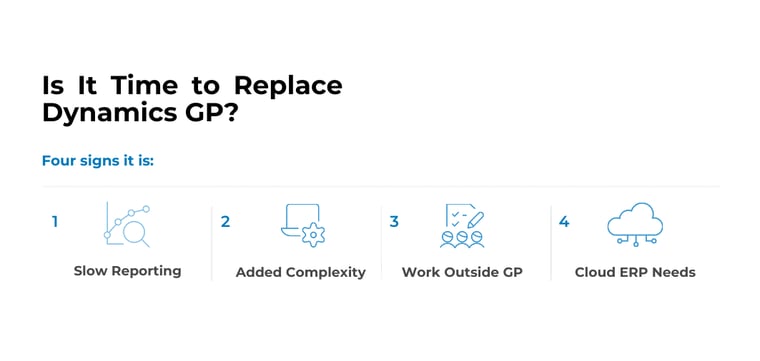
Here are four signs it may be time to start evaluating a Dynamics GP replacement.
Reporting Takes Too Long to Turn Into Useful Answers
Reporting is one of the clearest signs that a business may be ready for a modern ERP solution.
Dynamics GP may still hold important financial and operational data, but teams often need more than static reports or exported spreadsheets. Leaders need timely insight into cash flow, inventory, sales, projects, customer activity, purchasing, and overall performance.
If your team has to pull data from GP, export it into Excel, combine it with information from other systems, and manually check the numbers before reports can be shared, the process may be slowing down decision-making.
The issue is not always the data itself. The issue is how much work it takes to access, organize, and use that data.
A Dynamics GP replacement can help businesses move toward more connected reporting, dashboards, and visibility across departments. For organizations evaluating Acumatica ERP, reporting is often a major part of the conversation because teams want information that is easier to access, easier to understand, and easier to use.
Growth Has Added Complexity the Current System Is Harder to Support
As businesses grow, ERP needs change. A company may add new users, locations, entities, warehouses, product lines, service lines, customers, or reporting requirements. Processes that once worked well in Dynamics GP may start requiring more effort as the business becomes more complex.
That complexity can show up in different ways:
- Longer month-end close timelines
- More manual approvals
- Harder consolidated reporting
- More spreadsheet-based tracking
- Inconsistent processes between teams
- More work needed to get accurate information
At a certain point, the question becomes less about whether GP can still support the basics and more about whether the current ERP environment can support the next stage of growth.
For businesses comparing GP alternatives, this is an important shift. The next ERP system should not only replace what GP does today. It should also support where the business is trying to go next.
Too Much Work Happens Around GP Instead of Inside It
Many businesses have built tools and processes around Dynamics GP over time. That may include spreadsheets, custom reports, third-party applications, manual approvals, data exports, imports, or separate systems used by different departments. These additions often begin as practical fixes. One team needs a report. Another needs a tracker. Another needs a system to handle a process GP does not support well.
Over time, those fixes can become part of daily operations. The business may still say it runs on GP, but important work may actually be happening around GP. That can create duplicate data entry, inconsistent information, more manual checks, and heavier dependence on tools that were not designed to carry core business processes.
This is one of the clearest signs that a business should start evaluating its ERP upgrade strategy. A modern cloud business management software platform can help bring more of that work into one connected system, reducing the need for separate spreadsheets, disconnected tools, and manual handoffs.
The Business Needs a More Flexible Cloud ERP Foundation
Many Dynamics GP environments were built for a different way of working. Today, businesses often need cloud access, connected systems, easier updates, stronger visibility, and more flexible workflows. Teams may need to work across locations, access information remotely, connect ERP data with other business tools, or adapt processes as the company changes.
If the current GP environment depends on aging infrastructure, difficult upgrades, limited remote access, or extra IT effort to keep systems connected, it may be time to look at a modern ERP solution.
Cloud ERP software can give businesses a more flexible foundation for reporting, workflows, integrations, access, and long-term system planning.
For organizations considering Acumatica ERP, the value is not only moving to the cloud. It is moving toward a system that can support more connected operations and better visibility across the business.
What Should Businesses Do Before Replacing Dynamics GP?
Recognizing the signs does not mean the business needs to rush into a new ERP system. A better first step is to evaluate where Dynamics GP is helping, where it is creating extra work, and what the next system needs to support.
That may include reviewing:
- Current GP reports and dashboards
- Manual processes and spreadsheet-based work
- Integrations and third-party tools
- Growth plans and operational complexity
- Cloud access and reporting needs
- Department pain points
- Future ERP goals
This gives leadership a clearer starting point before choosing a Dynamics GP replacement or planning a Dynamics GP migration.
Start Evaluating Your Dynamics GP Replacement with Cloud 9 ERP Solutions
Replacing Dynamics GP is a major decision, but it can also be an opportunity to build a stronger ERP foundation for the business.
Cloud 9 ERP Solutions helps organizations evaluate their current GP environment, define priorities, and plan for a move to Acumatica Cloud ERP. As a Gold Certified Acumatica Partner, Cloud 9 brings experience with Dynamics GP migration, ERP planning, and Acumatica implementation.
If your business is starting to question whether GP still supports your operations, now is the time to begin the conversation.
Schedule a consultation with Cloud 9 ERP Solutions to start evaluating your Dynamics GP replacement.
FAQ: Dynamics GP Replacement
What is a Dynamics GP replacement?
A Dynamics GP replacement is an ERP system that takes the place of Microsoft Dynamics GP. For many businesses, this means moving from a legacy ERP system to a modern ERP solution that can better support reporting, workflows, integrations, visibility, and growth.
When should a business consider replacing Dynamics GP?
A business should consider replacing Dynamics GP when reporting takes too long, growth adds complexity, too much work happens outside of GP, or the business needs stronger cloud access, connected systems, and more flexible workflows.
What are common GP alternatives?
Common GP alternatives include modern ERP systems that support financial management, reporting, operations, integrations, and business visibility. For many organizations evaluating cloud ERP software, Acumatica ERP may be a strong option because it supports growing businesses with connected cloud-based tools.
Why move from Dynamics GP to Acumatica?
Besides the fact that the software is sunsetting, businesses may move from Dynamics GP to Acumatica when they need stronger reporting, better visibility, cloud access, connected workflows, and a system that can support future growth. Acumatica Cloud ERP can help reduce reliance on manual workarounds, disconnected processes, and outdated reporting methods.
How do you prepare for a Dynamics GP migration?
To prepare for a Dynamics GP migration, businesses should review how GP is used today, identify key reports and integrations, document manual processes, assess data needs, involve key users, and define what the next ERP system needs to support.
How can Cloud 9 ERP Solutions help with Dynamics GP replacement?
As an Acumatica partner, Cloud 9 ERP Solutions helps businesses evaluate Dynamics GP replacement options, review current system needs, define migration priorities, and prepare for Acumatica implementation. The team supports organizations moving from Dynamics GP to modern cloud business management software.