.webp?width=1153&height=571&name=Cloud9-Blue_Only-2%20Cloud%209%20Logo%20(1).webp "Cloud9-Blue_email3.png")
The right Acumatica partner for a Dynamics GP migration should understand legacy ERP transitions, data migration, implementation planning, integrations, user training, and post-go-live support. Businesses should choose a partner who can evaluate current GP workflows, identify process gaps, and guide the move to modern cloud ERP software.
For many businesses, Microsoft Dynamics GP has supported daily operations for years. But with Microsoft’s GP support timeline now in place, teams are starting to evaluate what comes next.
At Cloud 9 ERP Solutions, we believe a Dynamics GP migration should be treated as a business planning opportunity. Finding the right Acumatica partner can help you take stock of your current system, identify what needs to improve, and plan the move strategically.
What Is an Acumatica Partner?
An Acumatica partner is a business technology provider that helps companies evaluate, implement, configure, integrate, and support Acumatica. Acumatica builds the cloud ERP software. Partners help businesses apply that software to their operations, workflows, reporting needs, and long-term goals.
For companies planning a Dynamics GP migration, the partner role is especially important. A strong partner can help you look beyond the basic question of “what system should replace GP?” and focus on the bigger question: “what does the business need its next system to do better?”
Look for Experience With Legacy ERP Transitions and Dynamics GP Migration
Not every ERP project starts from the same place. A company implementing ERP for the first time has different needs than a company moving away from a long-standing legacy system. If your team has been using Dynamics GP for years, your next partner needs to understand the complexity that can come with that type of transition.
Your current GP environment may include:
-
Historical financial data
-
Custom reports
-
Third-party tools
-
Manual spreadsheets
-
Department-specific workflows
-
Older integrations
-
Processes that only certain team members fully understand
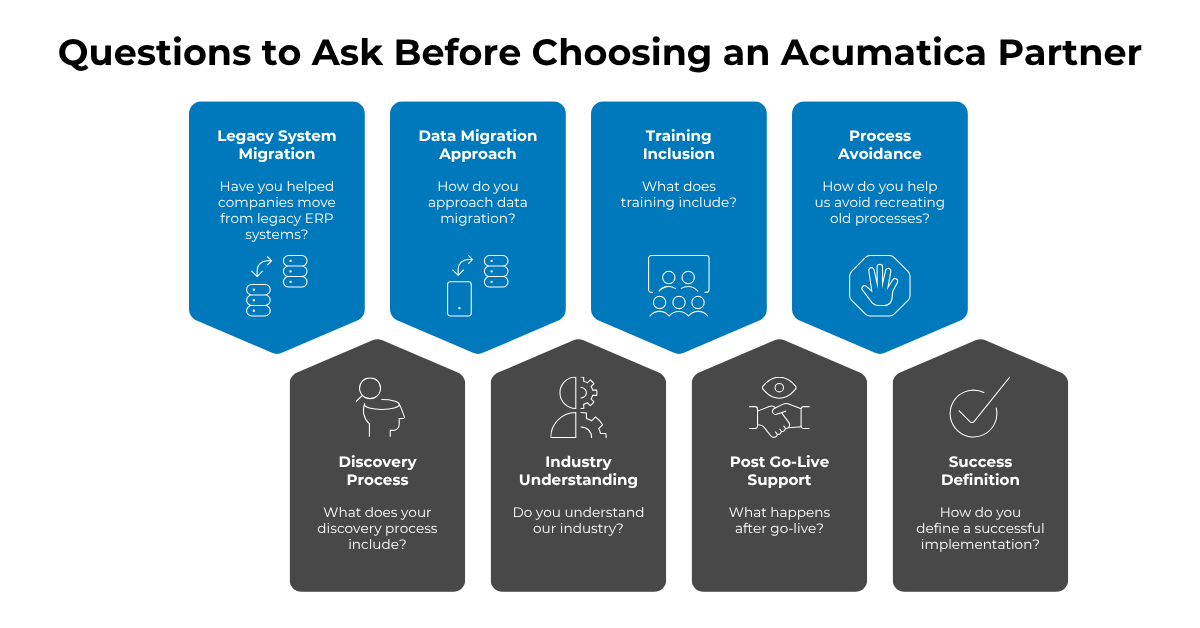
The goal is to find a partner who understands how legacy ERP decisions affect data, workflows, reporting, integrations, and user adoption. When evaluating Acumatica consultants, ask how they approach legacy ERP transitions. A strong partner should help you understand what needs to move, what needs to change, and what can be improved instead of recreated.
Start With Business Needs, Not Software Features
Before an Acumatica implementation begins, your partner should take time to understand your business. That means looking at how your company works today before making recommendations about the system. They’re not just going to copy your current GP setup into Acumatica. They need to understand what your business needs from its next ERP system.
A strong discovery process should include questions like:
-
What is GP handling for your business today?
-
What is still happening outside the system?
-
Where are teams relying on manual work?
-
Which reports are most important?
-
Which workflows are slowing people down?
-
What does leadership need better visibility into?
-
What does your next system need to support as the business grows?
These questions help turn the project into an ERP upgrade strategy rather than a basic software replacement. Instead of focusing only on modules and features, the right partner can help connect the implementation to revenue goals, cost control, process improvement, and better day-to-day visibility.
Ask About the Acumatica Implementation Process
Ask potential partners to walk you through their implementation process before the project begins. For a company moving from GP, the process should be structured enough to reduce risk but flexible enough to reflect how the business actually operates.
A strong Acumatica implementation partner should be able to explain how they handle each phase of the project.
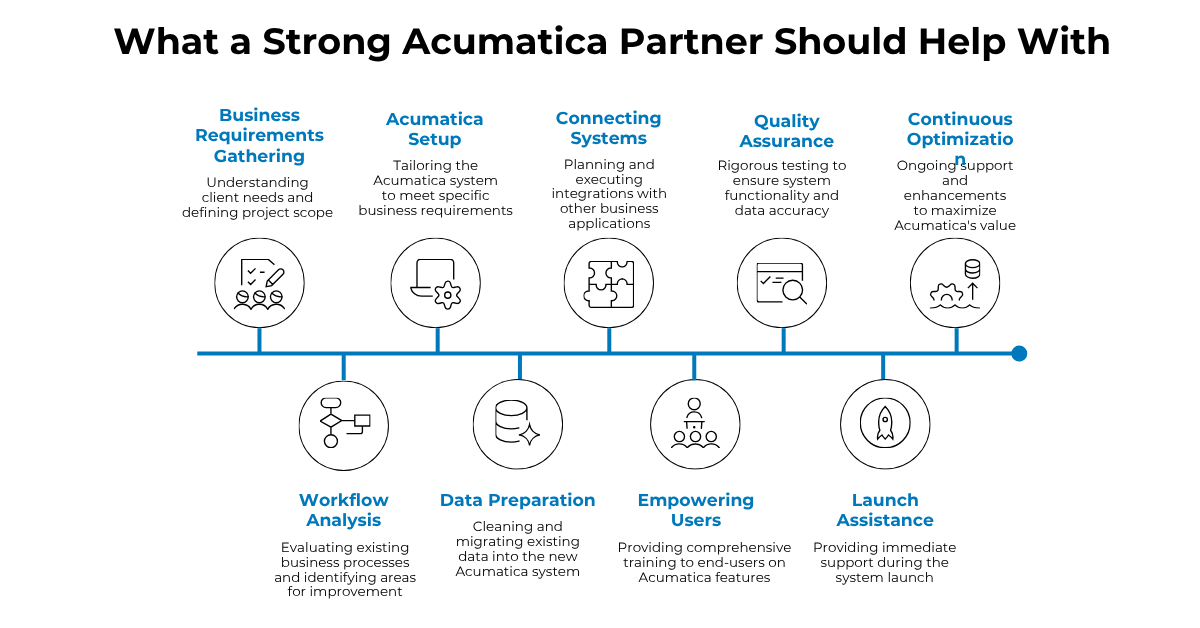
This helps your team understand how the partner manages risk, keeps the project moving, and supports users before and after launch.
Review Their Approach to Data Migration
Data migration is one of the most important parts of moving from Dynamics GP to Acumatica. Over time, legacy systems often collect outdated records, duplicate information, inconsistent naming, and data that no longer reflects how the business operates. Moving everything into a new system without review can create problems later.
The right Acumatica partner should help your team think through what data needs to move, what should be cleaned up, and how information will be tested before go-live. Clean data is essential for accurate reporting and user trust. If employees do not trust the new system after go-live, adoption becomes much harder.
Make Sure They Understand Your Industry
The right ERP partner should understand more than the software. They should also understand how your industry works.
-
A manufacturer moving from GP may need better visibility into production, planning, inventory, costing, and scheduling.
-
A distributor may need stronger purchasing, replenishment, order management, warehouse visibility, and profitability reporting.
-
An eCommerce business may need better connections between storefronts, inventory, fulfillment, and accounting.
These needs are not interchangeable. A strong Acumatica partner should be able to connect the system to your specific business model, workflows, and growth goals. Industry experience also helps your partner guide better conversations during discovery. They can ask sharper questions, identify common process gaps, and recommend an implementation path that fits how your specific business runs.
Think About Integrations and Customizations
Many GP users are not only using GP. They are also relying on other tools around it. Those tools may support CRM, payroll, eCommerce, warehouse management, reporting, sales, or other industry-specific workflows. Some may need to connect with Acumatica. Others may no longer be necessary once the new system is in place. This is where technical experience can help reduce risk.
A modern cloud ERP system can often reduce the need for disconnected tools, but that does not happen automatically. It takes planning.
Ask What Training and Support Look Like After Go-Live
A successful Acumatica implementation does not end when the system goes live. Your team will need training, support, and time to adjust. New questions will come up once employees begin using the system in real workflows. Reports may need to be refined. Processes may need small adjustments. Additional features may become more valuable after the foundation is in place.
That is why support should be part of the partner conversation from the beginning. A good partner should be prepared to support the system beyond launch. That long-term support can make a major difference in how well your team adopts the new platform.
Start Planning Your Dynamics GP Migration With Cloud 9 ERP Solutions
If your team is evaluating cloud business management software as part of a Dynamics GP replacement, Cloud 9 ERP Solutions can help you start with the right questions. As a Gold Certified Acumatica Partner, Cloud 9 ERP Solutions works with businesses to assess their needs, plan for implementation, and move toward cloud ERP software that supports how they operate today and where they want to go next.
Schedule a consultation with Cloud 9 ERP Solutions to start planning your move from Dynamics GP.
FAQs About Choosing an Acumatica Partner for GP Migration
What does an Acumatica partner do?
An Acumatica partner helps businesses evaluate, implement, configure, integrate, and support Acumatica. For companies moving from Dynamics GP, the partner can also help with discovery, data migration, workflow review, training, testing, and post-go-live support.
Why is the right Acumatica partner important for Dynamics GP migration?
The right partner can help your business approach migration as a broader planning decision. A Dynamics GP migration often involves legacy data, established workflows, custom reports, integrations, and process gaps that need to be reviewed before moving to a new cloud ERP system.
What should businesses look for in Acumatica consultants?
Businesses should look for Acumatica consultants with implementation experience, industry knowledge, data migration support, training resources, and a clear process for helping teams move from evaluation to go-live and beyond.
Is Acumatica a good Dynamics GP replacement?
Acumatica can be a strong Dynamics GP replacement for businesses that want modern cloud ERP software, flexible user access, stronger reporting, connected workflows, and a system that can scale with changing business needs. The right fit depends on the company’s current processes, industry, goals, and implementation plan.
When should businesses start planning a Dynamics GP migration?
Businesses should start planning early. A Dynamics GP migration can involve discovery, data cleanup, system evaluation, implementation planning, training, testing, and post-launch support. Starting earlier gives teams more time to evaluate options and make a better long-term decision.

%20(1)-1.png)